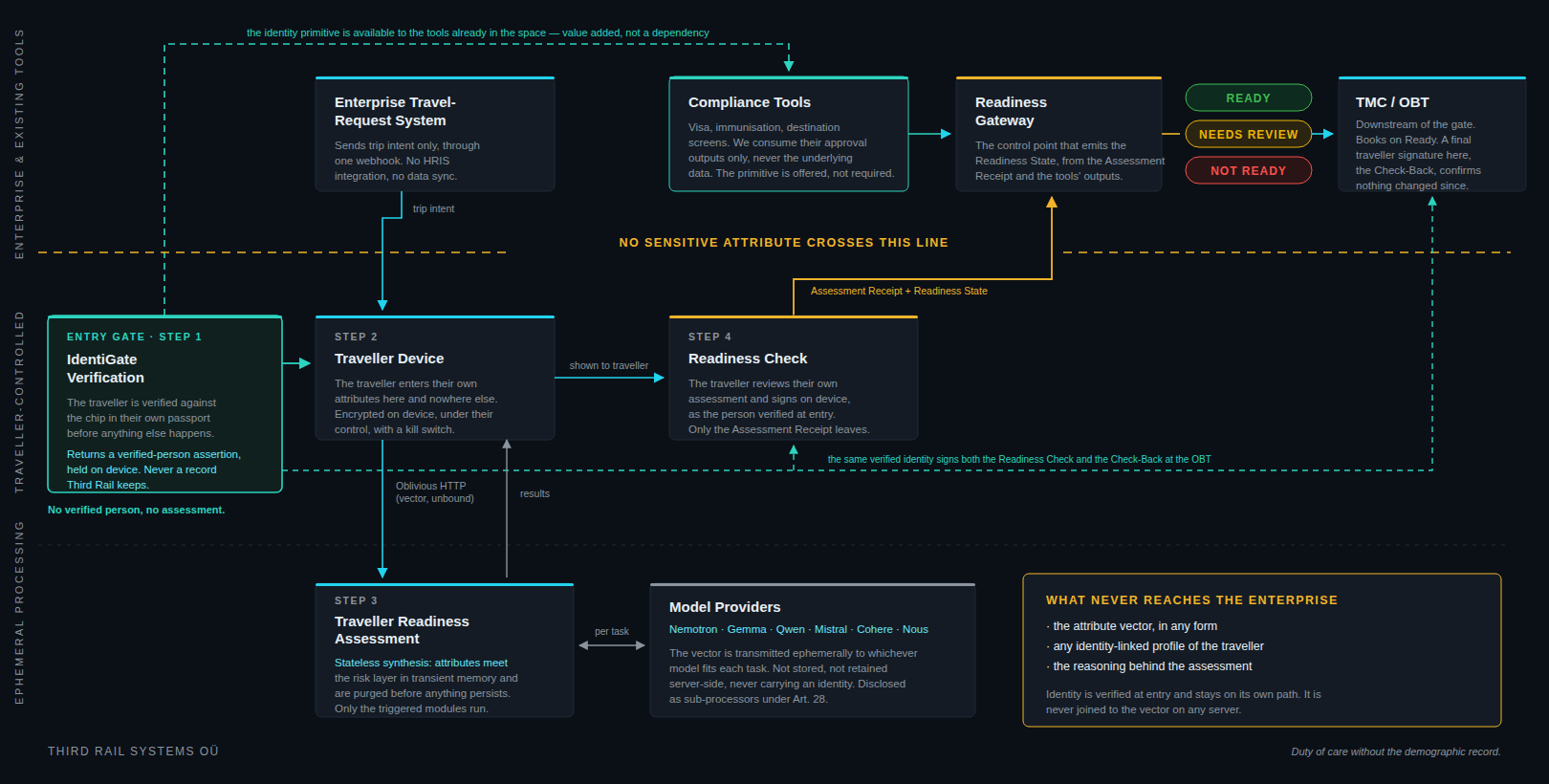
Third Rail Systems occupies the pre-booking Traveller Readiness layer between individualised travel-risk assessment and booking execution.
The purpose is simple:
Determine whether a traveller is ready to proceed with a trip before the enterprise commits to booking it.
Third Rail does not replace the systems enterprises already use for travel risk, booking, assistance, expense or policy.
It connects them.
The problem
Enterprise travel is already surrounded by specialist systems.
Travel risk platforms produce intelligence. Assistance providers provide intervention. TMCs and OBTs execute bookings. Enterprise policy engines define what is permitted.
What is missing is the decision layer between trip intent and execution.
Today, that gap is frequently bridged by people, email, spreadsheets, manual approvals or processes that happen after a ticket has already been issued.
Third Rail turns that gap into an API.
Identity verification is the entry gate
Identity verification is the entry gate, not a closing formality. Before a Traveller Readiness Assessment can be created at all, the traveller is verified against the chip in their own passport through IdentiGate. That verification returns a verified-person assertion held on the traveller's own device. Third Rail keeps no record of it.
This is the control that keeps the gate honest. No verified person, no assessment. A non-human actor cannot originate an assessment on a traveller's behalf.
The same assertion then stands behind every signature in the flow: the traveller signs the Readiness Check as the person verified at entry, and signs again at the Check-Back before booking. One verified identity, two signatures, no identity record held by Third Rail.
The architectural hierarchy
                    THIRD RAIL SYSTEMS
                           │
                  TRAVELLER READINESS
                           │
                 READINESS ASSESSMENT
                           │
                   READINESS CHECK
                           │
                   READINESS GATEWAY
                           │
                  ASSESSMENT RECEIPT
                           │
              ┌────────────┴────────────┐
              │                         │
        ENTERPRISE POLICY         BOOKING EXECUTION
              │                         │
         Enterprise              TMC / OBT / AI
What each layer does
Third Rail Systems The architecture and infrastructure company.
Traveller Readiness The category: determining whether an individual traveller is operationally ready for a proposed trip.
Readiness Assessment The private, identity-stripped evaluation of this traveller against this specific trip.
Readiness Check The traveller-facing step: the individual receives their assessment-generated guidance and acknowledges it.
Readiness Gateway The control point at the moment of booking. Assessment and booking are not always the same moment, so the Gateway revalidates the completed assessment against present conditions, confirms nothing material has changed since the assessment ran, and converts the result into a single machine-readable readiness state, without carrying the underlying personal context across it.
Assessment Receipt The evidence that the assessment process occurred: one sanitised record, held by the enterprise as its duty-of-care evidence.
Separation of responsibility
| System | Owns | Does not own |
|---|---|---|
| Traveller | Personal context and voluntary disclosure | Surrendering protected attributes to the enterprise |
| Third Rail | Readiness synthesis, state generation and attestation | Booking, ticketing or enterprise policy |
| Enterprise | Travel policy, thresholds and duty of care | Maintaining a central vulnerability database |
| Assistance provider | Confidential mitigation and support | Booking workflow orchestration |
| TMC / OBT / AI agent | Booking execution and itinerary management | Evaluating private traveller context |
The output
Third Rail does not need to become another system of record.
It produces a state:
Ready
Review
Not_Ready
and evidence that the assessment process occurred.
The enterprise decides what those states mean operationally.
Built to outlive today's booking stack
Third Rail integrates with existing OBTs and TMC infrastructure because that is where enterprise travel execution happens today.
But the architecture is not dependent on the OBT as the permanent endpoint.
The same readiness contract can be consumed by:
- TMC workflows
- OBTs
- travel-request systems
- assistance platforms
- enterprise policy engines
- autonomous travel agents
Readiness is separated from booking execution.
What Third Rail does and does not do
Third Rail performs the readiness assessment, produces the readiness state, provides evidence that the process occurred, and hands the state to the existing enterprise workflow.
It does not replace TMCs, OBTs, travel-risk platforms, assistance providers, enterprise policy systems, or booking and ticketing systems.
Read the architecture
- The Minimum-Disclosure Data Boundary: what data Third Rail actually receives, processes and retains.
- The Readiness Gateway: the control point between trip intent and booking.
- The Assessment Receipt: where the sanitised record gets its trust from.
- Security and data handling: transport security, application controls and retention posture.
- Direct Collection vs Minimum Disclosure: what asking the traveller directly actually costs.
- Why Not Deterministic Rules?: why the assessment is not a rules engine.
Related reading
Further depth for a technical reader: the Readiness API and why Traveller Readiness now.